
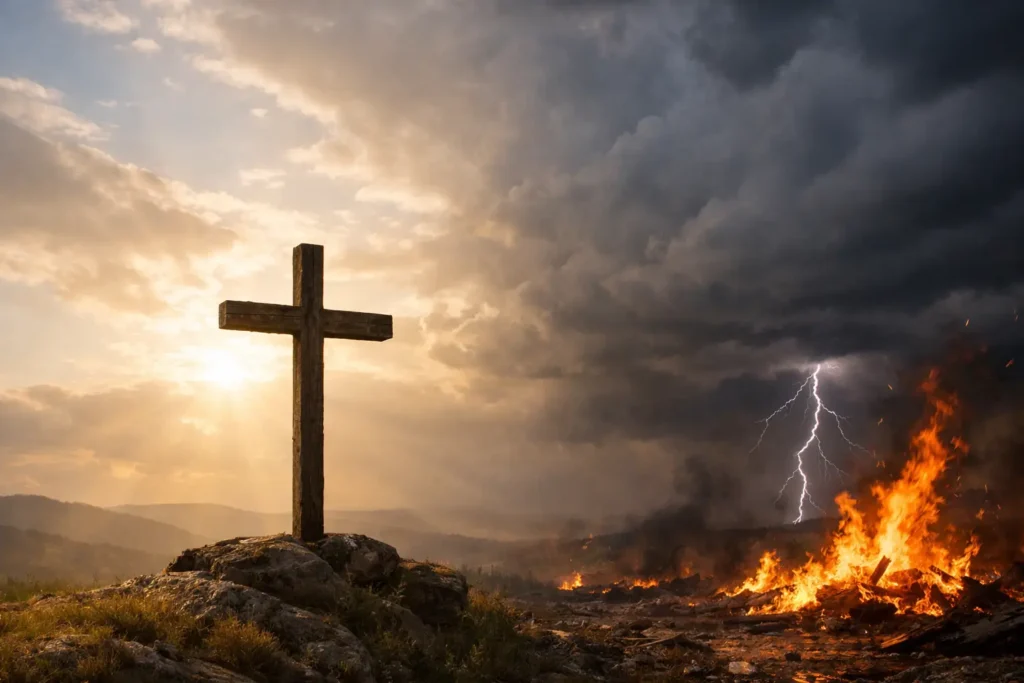
Some questions do not come from curiosity alone. They come from gravesides, hospital rooms, betrayal, abuse, war footage, and nights when prayer feels painfully quiet. If God is all-powerful and all-loving, why does he allow so much evil? That is not a cold philosophy question for most people. It is personal.
The Christian faith does not treat that question as silly, disloyal, or off-limits. The Bible itself is full of people asking God why evil seems to prosper and why suffering lasts so long. So if you have asked this, you are not standing outside the conversation. You are stepping into one that faithful people have wrestled with for centuries.
If God Is All-Powerful and All-Loving, Why Does He Allow So Much Evil?
A short answer is this: God created a world with real freedom, sin has deeply damaged that world, and God is not indifferent to evil even when He is patient in addressing it. Christianity does not say evil is an illusion. It does not say pain is always easy to explain. It says evil is real, tragic, and temporary, and that God has acted in history through Jesus Christ to defeat it.
That answer may still feel incomplete, because it is one thing to state ideas and another thing to sit with what they mean. So it helps to slow down.
Evil is not the way God made the world
According to the Bible, God created the world good. Evil was not part of His original design. The brokenness we see now is tied to humanity’s rebellion against God. Scripture calls that sin, and sin is not just rule-breaking. It is rejecting God’s authority, wisdom, and goodness.
That matters because it means Christianity does not place evil at God’s feet as though He delights in it. Famine, cruelty, murder, exploitation, and abuse are not signs that God enjoys suffering. They are signs that something has gone terribly wrong in a world that has turned from Him.
Some suffering is clearly connected to human choices. War, corruption, trafficking, violence, greed, and betrayal are not random glitches. They are moral evil. They come from real decisions made by real people. If we want a world where love is real, choices must also be real. And if choices are real, the possibility of rejecting love must also be real.
Why would God allow freedom if people use it for evil?
Because freedom is part of what makes love meaningful. A world of robots could be orderly, but it could not be loving in any deep sense. If human beings are made to know God, trust Him, and love one another, then they must be able to choose.
Of course, that raises the next question: couldn’t God give us freedom and still prevent the worst outcomes? Sometimes He does restrain evil. Christians believe God often does more protection in this world than we can see. But He does not remove all consequences or cancel every sinful act before it happens.
Why not? Part of the answer is that God is not merely trying to keep the world temporarily comfortable. He is carrying out a larger purpose that includes justice, mercy, repentance, redemption, and final judgment. That does not make evil good. It means God can permit what He hates for a time without surrendering His power or His plan.
Why does God allow suffering that is not directly caused by human choices?
This is where the question gets harder. Not all suffering comes in a way we can trace to one person’s decision. Disease, disasters, and sudden loss can feel different from crimes and cruelty. Christians have often called this natural evil, though that phrase can sound too clinical when real people are hurting.
The Bible teaches that human sin affected more than private morality. It brought fracture into the whole creation. The world we live in is not operating as it once did. That does not mean every illness or tragedy is a direct punishment for a specific sin. Jesus rejected that kind of simplistic thinking. But it does mean we live in a fallen world where death and decay are now part of the human experience.
That may explain something, but it may not satisfy emotionally. And that is understandable. Explanation and comfort are not always the same thing.
God has reasons, even when we do not see them clearly
One of the hardest parts of suffering is not just pain itself. It is not knowing why this pain, now, in this way. Christianity does not promise that we will get a full answer to every specific tragedy in this life.
The book of Job is helpful here. Job suffers terribly, and much of the book is a long wrestling match over why. In the end, God does not hand Job a neat, tidy explanation. He gives Job something deeper than a simple formula. He gives Job a clearer view of who God is.
That can sound unsatisfying until you realize the point. If God is truly God, then there will be moments when His wisdom exceeds our ability to map every detail. A child may not understand why a surgeon causes pain to heal. The gap between human understanding and divine wisdom is far greater.
That does not mean Christians shrug and say, “Who knows?” It means we admit limits without giving up trust. There is a difference.
The cross changes the conversation
If Christianity taught that God stays far away from suffering, many people would reject it immediately. But the center of the Christian faith is not a distant God watching pain from a safe height. It is God the Son entering human history in Jesus.
Jesus was not insulated from evil. He was betrayed, falsely accused, beaten, mocked, and crucified. He experienced grief, loss, injustice, and physical agony. At the cross, we do not see a God who is careless about suffering. We see a God who steps into it.
That does not answer every philosophical question, but it answers a relational one many people carry: Does God care? The cross says yes. And it says more than that. Jesus did not only share in human suffering. He came to deal with sin at its root.
Christians believe the death and resurrection of Jesus are God’s decisive answer to evil. Evil still exists now, but it is living on borrowed time. The resurrection means suffering and death do not get the final word.
God is patient, not passive
Another reason evil continues is that God is giving people time to repent. That can feel frustrating when we want immediate justice, and in many cases we should want it. The Bible is fierce about justice. God does not wink at evil.
But if God ended all evil instantly, none of us could stand on our own goodness. The Christian message is not that the world is divided into innocent people and obvious villains. It is that all of us have sinned and need mercy.
God’s patience means the door is still open. People can still turn to Christ. That patience is an expression of love, though it should never be confused with approval.
There will be a final judgment. Christianity is not built on the idea that evil is ultimately ignored. It is built on the promise that evil will be answered fully, either at the cross for those who trust Christ or in judgment for those who refuse Him.
What do we do with this question personally?
For some people, the problem of evil is mainly intellectual. For others, it is heartbreak wearing the clothes of a question. The response needs to match the wound.
If you are asking because you have been hurt, it may help to know that God does not ask you to pretend. The Psalms are full of cries, complaints, tears, and questions. Honest prayer is not unbelief. Sometimes it is the first real step toward God.
If you are asking because Christianity seems impossible in a suffering world, consider this: the existence of evil is actually easier to name if God exists than if He does not. If the universe is only matter and motion, then words like evil and injustice become harder to ground in anything objective. We may feel outrage, but why should moral outrage point to anything real beyond personal preference or social consensus? Christianity explains both why we recognize evil and why we long for justice.
That still leaves pain. And pain is not solved by argument alone. It often takes time, truth, prayer, and people who will listen without pretending easy answers are enough. That is one reason a ministry like Go Ask a Christian exists. Not to pressure people, but to make room for honest questions and point clearly to Jesus.
The deepest Christian answer to suffering is not that every dark thing makes sense right now. It is that God is good, evil is real, Christ has entered our pain, and history is moving toward a day when wrongs will be made right. Until then, you do not need to fake certainty you do not have. Bring the real question to God. Ask it plainly. He is not threatened by your honesty, and He is not absent from your pain.