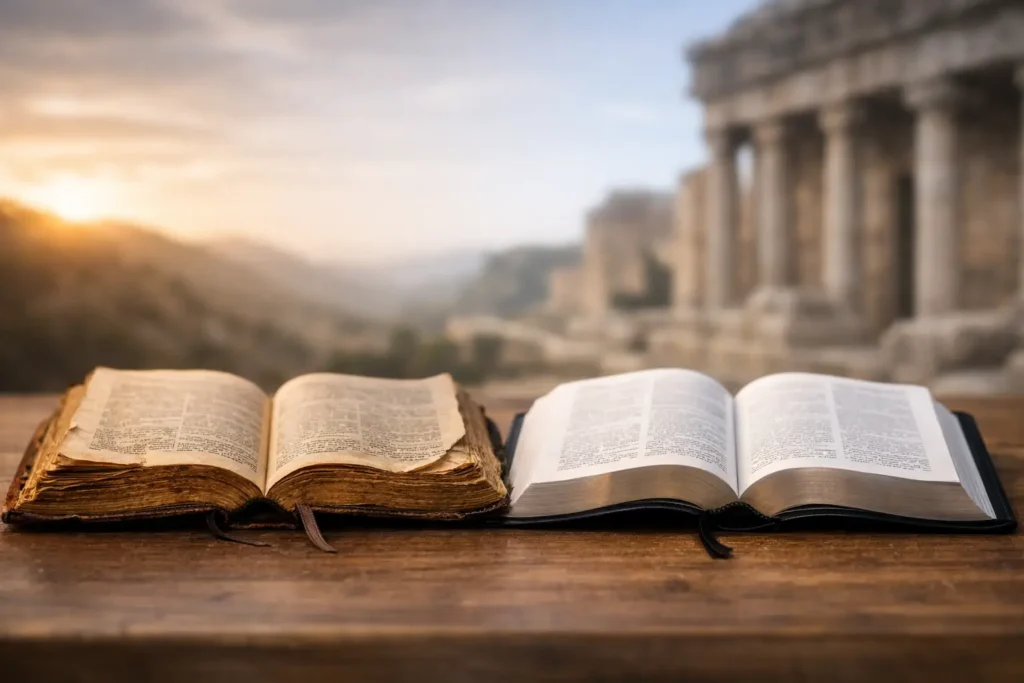
A lot of people ask this question after reading a few pages of Genesis, then opening the Gospels and feeling like they stepped into a different world. The language, the laws, the sacrifices, the kings, the prophets, and then suddenly Jesus, forgiveness, and the church – it can feel like two separate messages. So what is the difference with Old and New Testament of the Bible? The short answer is this: they are different parts of one story, and both reveal the same God.
What is the difference between Old and New Testament?
The word testament can also mean covenant, which is a binding promise or relationship. The Old Testament focuses on God’s covenant dealings before Jesus came into the world. The New Testament centers on Jesus Christ and the new covenant established through His life, death, and resurrection.
That does not mean the Old Testament is false and the New Testament replaced it like a corrected draft. It means the Old Testament prepares the way, and the New Testament shows the fulfillment. Promise first, fulfillment after. Shadow first, substance after.
If you miss that connection, the Bible can feel confusing. If you see it, the whole thing starts to hold together.
The Old Testament lays the foundation
The Old Testament begins with creation. It tells us who God is, why the world is broken, what sin is, and why humanity needs rescue. It introduces God’s holiness, justice, mercy, and patience. It also shows His covenant relationship with Israel, the people He chose for a specific purpose in history.
That purpose was never just about one ethnic group having special status. Through Israel, God was unfolding His plan to bring blessing to the nations. From the beginning, His plan had a global reach.
The Old Testament contains law, history, wisdom, poetry, and prophecy. It includes commands, sacrifices, priesthood, temple worship, and repeated reminders that sin separates people from God. Again and again, it shows that human beings do not fix themselves very well. Even with God’s law, people still rebel.
That matters because the law was not given as a ladder people could climb to earn salvation. It revealed God’s standard and exposed human need. It showed what righteousness looks like, but it also showed how far short we fall.
The New Testament reveals the fulfillment in Jesus
The New Testament opens with Jesus, and that changes everything. Not because God changed His personality, but because His long-promised rescue entered history in a person.
Jesus did not come to erase the Old Testament. He came to fulfill it. He fulfilled the law’s deepest meaning, fulfilled prophecy, and became the final sacrifice that the entire sacrificial system had been pointing toward.
In the Old Testament, sacrifices were offered again and again. In the New Testament, Jesus offers Himself once for sin. In the Old Testament, priests stood between the people and God. In the New Testament, Jesus is our great High Priest. In the Old Testament, the temple was the center of worship. In the New Testament, God’s presence comes to dwell with His people through the Holy Spirit.
This is why Christians talk so much about grace. The new covenant does not lower God’s standard. It provides what we could never achieve on our own. Forgiveness is not pretending sin does not matter. It is God dealing with sin fully through Christ.
Is the God of the Old Testament different from the God of the New?
This is one of the biggest struggles people have, and honestly, it is an understandable question. The Old Testament can feel severe, while the New Testament can feel tender. But the difference is not that God was angry before and loving later.
The same God is present in both testaments. In the Old Testament, He is not only just. He is also compassionate, patient, and merciful. He repeatedly forgives, restores, and calls people back. In the New Testament, He is not only loving. He also speaks of judgment, holiness, and the seriousness of rejecting truth.
Jesus Himself talks more about judgment than many people expect. And the Old Testament is filled with stunning pictures of God’s mercy.
What changes between the testaments is not God’s character. What changes is where we stand in the storyline. The Old Testament is largely anticipation. The New Testament is fulfillment. The cross becomes the clearest place where God’s justice and love meet together.
A key difference: law and grace
When people ask what is the difference between Old and New Testament of the Bible, this is often what they mean. Is the Old Testament about law and the New Testament about grace?
Yes, but that needs care. Grace is not absent from the Old Testament, and law is not absent from the New. God has always saved people by grace through faith. Abraham trusted God. David cried out for mercy. The prophets called people back to heartfelt faith, not empty religion.
At the same time, the New Testament still contains commands. Jesus calls people to repent, obey, love God, love their neighbor, and follow Him. So the contrast is real, but it is not simplistic.
The law in the Old Testament revealed sin and pointed toward the need for atonement. The New Testament reveals that Jesus is the atonement. The old covenant had sacrifices that symbolized cleansing. The new covenant provides the true cleansing those sacrifices pointed toward.
So the difference is not works versus no morality. It is the difference between preparation and completion, symbol and reality, waiting and arrival.
Why the Old Testament still matters
Some people assume Christians can skip the Old Testament because they live under the new covenant. But if you remove the Old Testament, you lose the meaning of the New.
Without Genesis, you lose creation, the fall, and the beginning of God’s redemptive plan. Without Exodus, you lose the pattern of rescue. Without the law, you lose a clear picture of God’s holiness. Without the Psalms, you lose language for sorrow, worship, fear, and hope. Without the prophets, you lose the promises that Jesus fulfills.
The Old Testament also helps us understand why Jesus came. He did not appear in a vacuum. He came as the promised Messiah, the Son of David, the suffering servant, the true Passover Lamb.
That said, Christians do read the Old Testament through the lens of Christ. Not every command given to ancient Israel applies directly in the same way today. Civil laws for Israel’s national life, temple regulations, and sacrificial commands belonged to a specific covenant setting. The moral truths behind them still reveal God’s character, but their role must be understood in light of Jesus.
That is where a lot of confusion happens. People read commands given to Israel as if they were dropped unchanged into every culture and moment. Sometimes the answer really is, it depends on what kind of law you are talking about and where it fits in the Bible’s larger story.
Old Testament and New Testament in one sentence each
The Old Testament says, in many ways, the Savior is coming.
The New Testament says, Jesus is that Savior.
That is simple, but it is not shallow. The whole Bible moves in that direction.
How this changes the way you read the Bible
If you are new to the Bible, do not start by treating it like a random collection of spiritual quotes. Read it as one unfolding story. God creates. Humanity falls. God promises redemption. He forms a people. He gives His law. He sends prophets. Then Jesus comes, lives without sin, dies for sinners, rises again, and calls people everywhere to repent and believe.
That means the question is not only academic. It becomes personal. The difference between the Old and New Testament is not just about sections of a book. It is about whether you understand what God has done to bring sinners back to Himself.
And that is where this becomes good news. You do not need to clean yourself up enough to earn God’s acceptance. You do not need to pretend your questions are not real. The Bible is honest about sin, suffering, justice, guilt, mercy, and hope. It tells the truth about us, and it tells the truth about Jesus.
If you have ever felt like the Bible was confusing or even contradictory, you are not alone. Many people ask that very question in public conversations with Go Ask a Christian. Usually, what helps most is seeing that the Bible is not telling two competing stories. It is telling one true story that reaches its center in Christ.
So if you are wondering where to begin, start with this: the Old Testament prepares you to understand Jesus, and the New Testament shows you why He matters. Read both slowly. Ask honest questions. Pay attention to what they reveal about God’s holiness, humanity’s need, and Christ’s rescue.
You do not need to have it all figured out before you come to God. But you should know this – from the first pages to the last, the Bible is pointing you toward Him.