
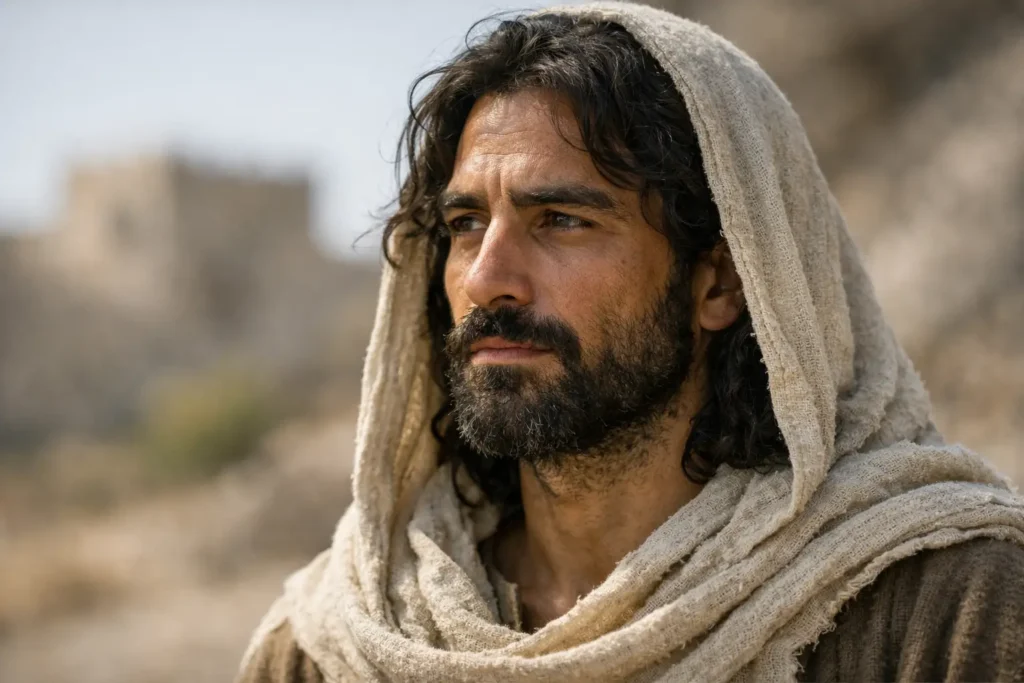
For many people, the question, “what did Jesus really look like? exploring his ethnic background,” is not a small detail. It touches identity, history, and whether Christianity has been presented honestly. If you grew up seeing Jesus portrayed only as a pale European man with light hair and blue eyes, it is fair to ask whether that image reflects history or tradition.
The honest answer is that we do not have a photograph, a detailed physical description, or a first-century portrait labeled, “This is Jesus.” But we do have strong historical context. It tells us something clear: Jesus was a Jewish man from the Middle East, born into the Jewish people of first-century Roman Judea and raised in Galilee.
That truth does not make Jesus less approachable to anyone. It reminds us that he entered a real place, among real people, under political pressure, economic hardship, and religious tension. God did not become human in an imaginary, cultureless world.
Jesus Was Jewish, Not European
Jesus was born to Mary, a Jewish woman. He was circumcised as an infant according to Jewish law, presented at the temple in Jerusalem, attended Jewish festivals, read and taught from the Hebrew Scriptures, and worshiped in synagogues. His earliest followers were also Jewish.
The Gospels place him in the land often called Judea, though his hometown of Nazareth was in Galilee, a northern region with its own accent and reputation. When people heard Jesus speak, they would have recognized him as a Galilean Jew. In fact, after Jesus’ arrest, Peter was identified by his Galilean speech.
This matters because Christianity is sometimes described as a Western or European religion. Christianity has deeply shaped Europe and North America, but it did not begin there. Its roots are in the Middle East. Jesus was not a European Christian who started a new religion detached from Judaism. He was the Jewish Messiah promised in Israel’s Scriptures, and his first disciples came to believe that his good news was for every nation.
What Did Jesus Probably Look Like?
History can give us a reasonable picture, but not a precise face.
Jesus likely had brown skin, dark eyes, and dark, curly or wavy hair, as was common among Jewish men of the region. He probably looked like the people around him, not like later European paintings. He may have been of average height for a first-century Jewish man, though no source gives us his measurements. He worked with his hands as a tekton, a Greek word that can refer to a builder or craftsman. That likely meant a physically demanding life.
He also probably wore the ordinary clothing of his community: a tunic, an outer cloak, sandals, and a prayer garment with fringes, in keeping with Jewish practice. There is no historical reason to picture him in the flowing white robes and spotless appearance common in religious art.
At the same time, we should be careful not to replace one overly confident image with another. We cannot say exactly what shade of skin Jesus had, how long his hair was, or whether he had a beard of a particular style. Reconstructions are educated estimates, not certainty.
Did Jesus Have Long Hair?
Many paintings show Jesus with long, straight, light-brown hair. That picture became familiar through centuries of European art, not through a clear Gospel description.
Paul writes in 1 Corinthians 11 that long hair was generally considered dishonorable for men in his cultural setting. That passage is not a physical description of Jesus, and it should not be used as absolute proof of his hairstyle. Still, it gives us reason to question the familiar Western image. Jesus likely wore his hair in a customary first-century Jewish style, probably shorter than many traditional paintings suggest.
Does the Bible Describe Jesus’ Appearance?
The Gospels do not give us a detailed description of Jesus’ face, height, skin tone, or hair. That silence is meaningful. The writers wanted us to know what Jesus did, what he taught, why he died, and that he rose again.
Isaiah 53 says that the suffering servant had no outward beauty or majesty that would naturally draw people to him. Christians have often understood this passage as pointing to Jesus. It does not mean Jesus was unattractive. It does suggest that his power and significance were not based on celebrity appearance.
The book of Revelation uses vivid imagery to describe the risen and glorified Christ: hair white like wool, eyes like fire, and feet like glowing bronze. This is a vision full of symbolism, not a police-sketch description of Jesus during his earthly ministry. It communicates his holiness, authority, and glory.
Ethnicity, Race, and the First-Century World
Modern racial categories do not fit neatly onto the ancient world. People in Jesus’ day knew family lines, languages, regions, tribes, and nations. They understood that Jesus was Jewish, from Galilee, and connected to the people of Israel. They did not use today’s categories in the same way we do.
So it is most accurate to say Jesus was ethnically Jewish and Middle Eastern. He lived in a land shaped by Jewish, Roman, Greek, Samaritan, and neighboring cultures. Aramaic was likely his everyday language. He also knew Hebrew through Scripture and worship, and he may have had some familiarity with Greek, which was widely used in the region.
Calling Jesus Jewish does not deny that he is Lord for people of every background. It grounds the Christian message in history. God made promises through Abraham and Israel, and Christians believe those promises reach their fulfillment in Jesus. Then, through Jesus, the invitation goes outward to the whole world.
Why So Many Images Show a White Jesus
Artists often paint Jesus in ways familiar to their own communities. European artists painted a European-looking Jesus. Ethiopian artists have portrayed him in African settings. Asian artists have portrayed him with Asian features. These images can help communities see that Jesus welcomes them and understands human life.
The problem begins when one cultural image is treated as the historical truth or as evidence that Jesus belongs more to one group than another. A white European Jesus is not the most historically likely portrait of the first-century Jewish man from Nazareth.
This issue carries real pain because some people have used Christian language and European-looking images of Jesus to support colonialism, racism, slavery, or cultural superiority. Those actions were not faithful expressions of Jesus’ teaching. Jesus commanded love of neighbor, welcomed outsiders, confronted hypocrisy, and gave his life rather than taking power through violence.
Christians should not dismiss the harm done in Jesus’ name. We can tell the truth about it while also recognizing that misuse does not erase Jesus himself. The abuse of a message is not the same as the message. Jesus calls every culture, including cultures shaped by Christian history, to repentance, humility, and love.
Jesus Does Not Ask You to Erase Your Heritage
Following Jesus is not an invitation to become culturally European, American, or anything else. It is an invitation to trust him. The Bible’s final vision includes people “from every tribe and language and people and nation” worshiping God. Their unity is real, but their diversity is not erased.
Every culture, including Jewish, Canadian, European, African, Asian, and Indigenous cultures, contains beautiful gifts and broken patterns. No culture is beyond God’s love, and no culture is above God’s truth. Faith in Jesus may challenge parts of our lives, but it does not require us to hate where we come from.
For people asking this question in Kingston, Oshawa, Peterborough, or any community where many backgrounds meet, that can be a freeing truth. Jesus is not the property of one race or nation. He is the Middle Eastern Jewish Messiah who came for the world.
The Face Behind the Question
Sometimes the question of Jesus’ appearance is really asking something deeper: Would Jesus see me? Would I be welcome near him? Does Christianity have room for people like me?
The Gospels answer with the way Jesus treated people. He spoke with a Samaritan woman, touched those others avoided, welcomed children, ate with social outsiders, and responded to a Roman centurion’s faith. He did not flatten people’s stories, but he did invite them into the same grace and truth.
We may never know every detail of Jesus’ earthly appearance. But we know enough to let go of the false idea that he was a white European figure removed from the Middle East and from Jewish history. And we know the heart revealed in his words and actions: “Come to me.” You do not need to have every question figured out before you begin asking him who he is.